
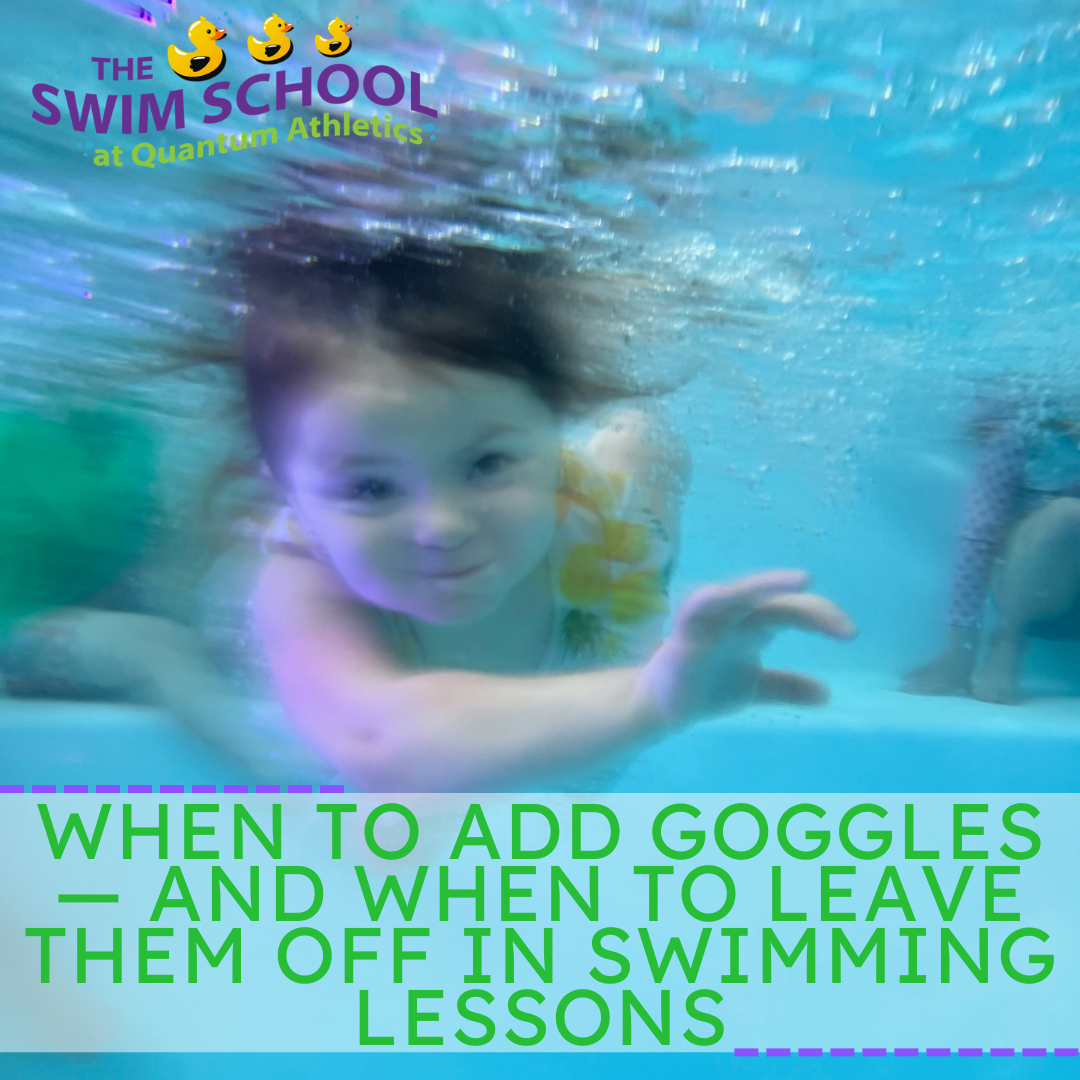
When to Add Goggles — and When to Leave Them Off in Swimming Lessons
By Samantha, Owner of The Swim School at Quantum
Goggles: Helpful Tool or Unnecessary Crutch?
If you’ve ever watched your child’s swim lesson, you’ve probably seen some kids wearing goggles and others going without. Parents often ask me:
“Should my child wear goggles in swimming lessons?”
The answer is… both!
At The Swim School at Quantum, serving families in Lockwood, Stockton, Greenfield, Lamar, and surrounding Missouri towns, we use a balanced approach. Goggles are a fantastic tool — but only after a child learns the essential skills they need to stay safe in the water without them.
Why Learning Without Goggles Comes First
1. Safety in Real-Life Situations
In an emergency, children won’t have time to grab goggles.
If a child falls into a pool, slips off a dock, or gets splashed unexpectedly, they need to be able to:
-
Open their eyes underwater
-
Orient themselves
-
Float
-
Roll to breathe
-
Swim to safety
Teaching these essential skills without goggles helps children feel confident and capable in unexpected situations — which is exactly why goggle-free learning is part of our survival swim lessons.
2. Water Comfort & Body Awareness
Kids who only swim with goggles often become dependent on them. Without goggles, they may:
-
Close their eyes completely
-
Panic about water touching their face
-
Lift their head too high
-
Lose their balance
-
Forget their breathing
Comfort in the water starts with being able to put your face in, blink underwater, and keep calm — all without equipment.
3. Better Floating & Breathing
Kids wearing goggles sometimes forget to focus on:
-
Relaxing their face
-
Proper breathing
-
Natural eye movement
Floating, rolling, and survival breathing all rely on calm movements. When children practice without goggles, they learn to trust the water, regulate their breath, and maintain their body position.
When Goggles ARE Helpful in Swimming Lessons
Once a child is comfortable swimming and floating without goggles, adding goggles can be extremely beneficial — especially during indoor swimming lessons when kids want to explore more skills.
Here’s when we recommend goggles:
1. Skill Development & Stroke Technique
When kids advance into longer swims and proper strokes, goggles help them:
-
Keep their eyes open
-
Maintain proper head position
-
Focus on the instructor
-
Reduce the urge to lift their head
This leads to cleaner freestyle, better backstroke bodyline, and stronger kicks.
2. Confidence & Enjoyment
Seeing clearly underwater makes swimming feel more fun and less intimidating. Kids love exploring underwater, grabbing rings, and seeing their friends.
Confidence is key — and goggles help many children feel braver during underwater tasks.
3. Sensitive Eyes or Chlorine Concerns
Some kids do have more sensitive eyes, especially in chlorinated indoor pools. Goggles can reduce irritation and help these swimmers focus on learning instead of rubbing their eyes. Luckily, our Salt water pool eliminates this problem you see with chlorinated pools!
How We Balance Goggle Use at The Swim School at Quantum
Our approach is simple:
Start Without Goggles
Especially in:
-
Baby & toddler swim classes
-
Beginner swimming lessons
-
Survival swim lessons
Children learn how to handle water on their face, blink underwater, float calmly, and breathe naturally.
Introduce Goggles Later
Once a child can:
✔ Put their face in the water
✔ Float confidently
✔ Roll to breathe
…then goggles can be added for a portion of the lesson.
Use Both During the Same Lesson
For many children, the perfect balance is:
-
First half: No goggles — focus on survival skills, floating, and breathing
-
Second half: Goggles on — work on skills, confidence, and fun underwater exploration
This gives kids the best of both worlds:
Safety + Confidence + Skill Development
Why Practicing Both Ways Makes Stronger Swimmers
Kids who can swim both with and without goggles become more adaptable, more confident, and ultimately safer around water.
Here’s what that looks like in action:
With goggles:
-
Long swims
-
Underwater games
-
Stroke technique
-
Jump & retrieve skills
Without goggles:
-
Floating
-
Rolling to breathe
-
Orientation skills
-
Survival swimming
-
Water safety awareness
Balance is key. We want children to enjoy swimming — but also to be prepared when conditions aren’t perfect.
Common Parent Questions About Goggles
“My child hates water on their face. Should we start goggles right away?”
Not at first.
Introducing goggles too early can make the sensitivity worse.
We gently help children get comfortable with face-in-water skills — then add goggles once they’re ready.
“Is it okay if my child only likes goggles?”
We encourage goggle use for fun and technique, but every child must practice some skills without goggles for safety.
“Should my toddler wear goggles?”
Generally, no.
Toddlers in swimming lessons and survival swim classes need to learn natural water comfort first.
Why This Matters for Families in the Lockwood Area
Here in Missouri, families spend a lot of time around lakes, ponds, creeks, and backyard pools.
Real water scenarios are unpredictable — and goggles aren’t guaranteed.
Our goal is to help every child become:
-
Safe
-
Confident
-
Prepared
-
Skilled
-
Calm in unexpected situations
Whether it’s indoor swim lessons in fall and winter or outdoor pool fun in summer — being able to swim confidently both with and without goggles makes all the difference.
Final Thoughts: Goggles Are a Tool — Not a Requirement
Goggles are wonderful for comfort, fun, and stroke work.
But the most important skills your child learns in swimming lessons — floating, rolling, breathing, and surviving — must be learned without them.
At The Swim School at Quantum, we teach both because we want kids to enjoy swimming and stay safe in any situation.
When children learn:
✨ How to float without fear
✨ How to breathe without lifting
✨ How to orient themselves without relying on goggles
…they’re not just better swimmers.
They’re safer swimmers.
And that’s our priority.
