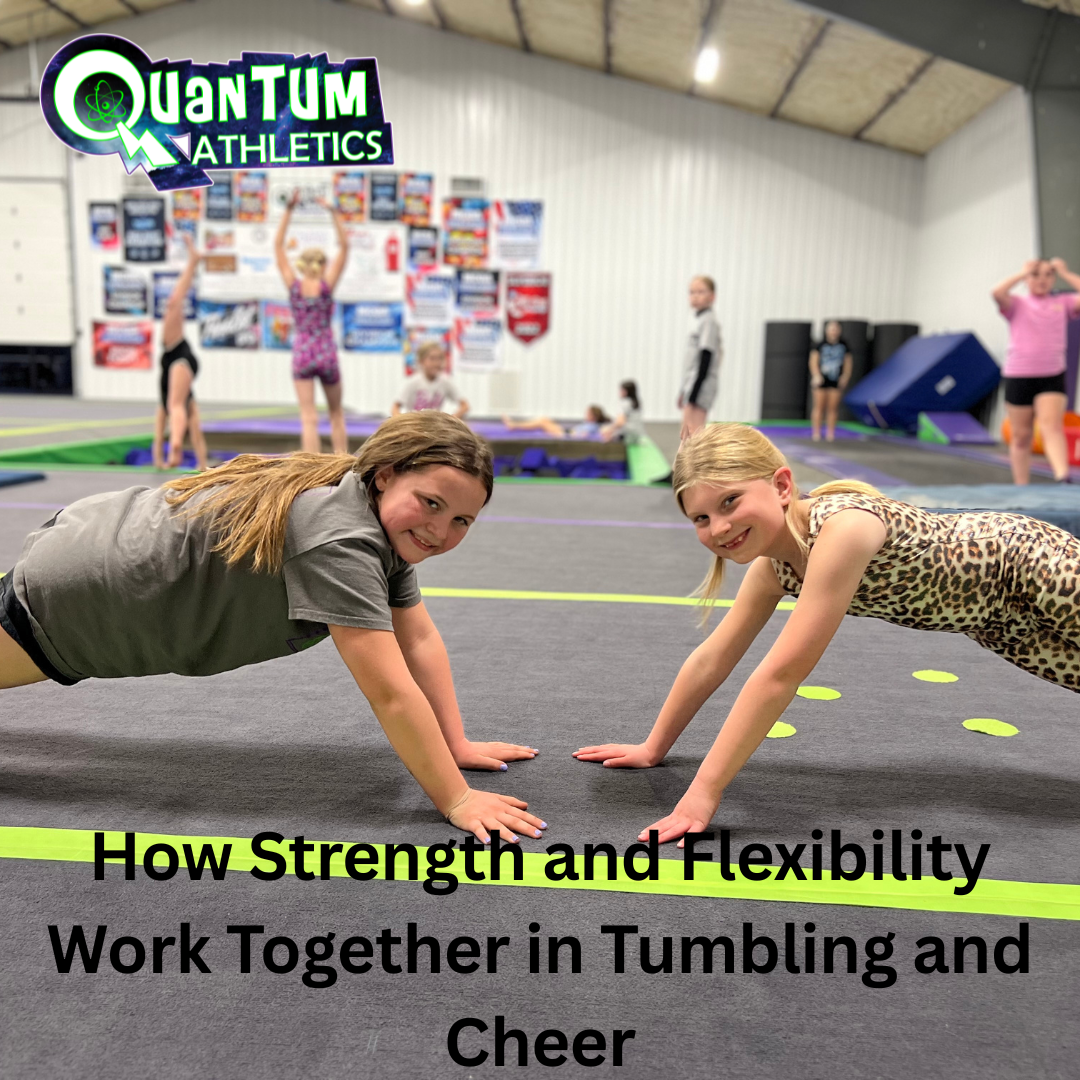
How Strength and Flexibility Work Together in Tumbling and Cheer
When parents think about tumbling and cheerleading, they often imagine high-flying stunts, powerful tumbling passes, and the dazzling confidence athletes bring to the floor. But behind every clean back handspring or perfectly pointed toe lies the same essential foundation: the partnership between strength and flexibility. At Quantum Athletics, we train young athletes to understand why these two qualities matter — and how they work together to make cheer and tumbling safer, stronger, and more successful.
Why Strength & Flexibility Matter More Than Ever
In modern youth tumbling and cheer, athletes are expected to move with both power and precision. Whether a child is working on basic skills or advancing toward elite-level passes, the body must not only bend and stretch — it must control those movements.
Strength helps athletes:
-
Support their own body weight
-
Generate explosive power for jumps and tumbling
-
Maintain tight shapes in the air
-
Protect joints from impact
-
Build stability in stunts and handstands
Flexibility helps athletes:
-
Improve range of motion
-
Create cleaner lines (think splits, jumps, and body shapes)
-
Reduce risk of strains and pulls
-
Achieve proper technique in bridges, walkovers, and leaps
These two elements work like a push and pull system — one never succeeds without the other.
How Strength and Flexibility Work Together (The Science Behind the Skills)
Athletes with excellent flexibility but poor strength struggle to control their bodies. You’ll see loose movements, bent arms, or wobbly landings. On the flip side, athletes with strength but limited flexibility often compensate with improper technique, leading to frustration or injury.
In tumbling and cheer, synergy is everything:
-
A flexible back is important, but strong core and shoulder muscles keep bridges and walkovers safe.
-
Flexible hips help create beautiful jumps, but strong quads, glutes, and calves provide the height.
-
Loosened hamstrings increase kick height, but strong lower-body muscles control the landing.
-
Shoulder flexibility sets up a strong handstand, but stability in the back and arms keeps you inverted.
When strength and flexibility develop together, athletes move smoother, safer, and with far more confidence.
The Quantum Athletics Approach: Balanced Training for Real Results
At Quantum Athletics, our tumbling and cheer programs are intentionally designed to train strength and flexibility in a way that supports skill progression.
1. Dynamic Warm-Ups
We start every class with a warm-up that blends cardio, mobility work, and muscle activation. This prepares joints and muscles while improving long-term flexibility.
2. Skill-Specific Conditioning
Our conditioning is always tied directly to the skills athletes are learning. Examples include:
-
Hollow holds
-
Handstand shape drills
-
Hip-opening exercises
-
Leg and ankle strengthening for jumps
This creates stronger, cleaner technique.
3. Safe Progressive Flexibility Training
We incorporate:
-
Active stretching
-
Controlled leg lifts
-
Bridge and shoulder mobility work
-
Split progressions
Our coaches ensure athletes stretch safely — never forcing, always encouraging.
4. A Whole-Body Approach
Instead of isolating one muscle group, we teach athletes to understand how the body works as a system. This produces better results and reduces injury risk.
Common Skills That Require Both Strength and Flexibility
Here are just a few tumbling and cheer skills that rely heavily on the combination of both:
-
Backbends & Bridges: shoulder flexibility + back/arm strength
-
Front/Back Walkovers: spine flexibility + core and leg strength
-
Cartwheels & Round-Offs: hip flexibility + wrist and shoulder strength
-
Jumps (Toe Touch, Pike, Hurdler): hip and hamstring flexibility + explosive leg power
-
Back Handsprings: shoulder flexibility + strong legs, core, and arms
When one component is missing, the skill becomes harder and less safe.
How Parents Can Support Their Athlete at Home
Strength and flexibility don’t end when class is over. Parents can help by encouraging:
-
Short stretching sessions at home
-
Light core work a few times per week
-
Practicing body shapes like hollow and arch holds
-
Proper rest and hydration
Small, consistent habits make big impacts on progress.
The Bottom Line: Strength + Flexibility = Confident, Capable Athletes
To excel in tumbling and cheer, young athletes need more than natural talent — they need a balanced foundation. At Quantum Athletics, we help children build the strength to support their skills and the flexibility to move with grace and proper technique.
The result?
Powerful, safe, confident athletes who love what they do.
